Notes are a memory hole

And I think they’re laughing at me, too

April 2019: Writing these notes is all I need to remember exactly what I was thinking when I was reading this!

November 2020: What. Is. An “SS-p”?!? Which part of Agyeman was I even Cf.-ing about? How the hell am I referencing Latour in these margin notes when I hadn’t even read it at that point?

Completing my exams this fall has been the biggest smackdown over how I handle reading. So much earlier work might as well not have been done at all: just a lot of wasted time. I’m re-reading entire books’ worth of background that I already read a year and a half ago. I put my notes in notebooks (if I’m lucky – sometimes they live and die in the margins) and then absolve myself of any further effort. This is clearly not going to be able to continue.

I’ve read a lot about the Zettelkasten method, and it looks ideal, but for two things: (1) its parsimonious note-taking prescription doesn’t seem to acknowledge the more extensive notes you’ll need to take when you’re trying to gain and straighten out foundation knowledge of something, and (2) tools for doing it either seem creaky and unreliable, have an unacceptable learning curve (tiddlywiki), or are expensive (like Roam). So right now, my notes are siloed in notebooks, Scrivener cards, Zotero entries, and who know where else.

I don’t have the mental space (or the time at all) to do anything useful about it until I get past exams, but this just has to change. My memory is failing more and more, and I just can’t make connections like I used to.
Stop clicking

Can you just give it a minute

Realizing in this cascading crisis of exhaustion and burnout that if I don’t start including at least one planned day of non-work in my schedule each week, I’m going to remain in trouble. It doesn’t help if I get so wound up that a morning going wrong or a day with staggered appointments that I can never really get back to work in between forces me to take the day off academic work in a way I hadn’t budgeted for. I actually have to know it’s coming. Throw all my normal worry-bits into it. Make it sacred me-time, even if that works out to the doctor and holiday decorations and calling my aunt and washing the floors. (At this point, as long as it doesn’t involve parsing or formulating an argument, it’s me-time.)

I do better when I come back to work after these breaks, too. Not just because I’m rested, but because what I’d been juggling has time to kick around in my head unhassled, like not repeatedly clicking a link that’s taking a while to load.

Understanding isn’t linear

Can I please internalize the “sideways” thing already

The Robbins (2012) Political Ecology text gave me so much trouble when I tried to go straight back into it as a “refresher” before diving into my other accumulated political ecology readings. I kept opening and then closing it, and I couldn’t figure out why – I had already pushed through it once, a year and a half ago. After giving myself permission to read anything else, it made sense. It turns out that I’d gotten everything I could out of Robbins until I went into the other perspectives and realized what I’d gotten wrong or incomplete in my first read of the book. Now I can understand – and place properly within political ecology thought – things that eluded me before (in some cases without knowing it), like the Chapter 3 section “Objects, Actor-Networks, and the Problem of Materiality,” his words on subjects and governmentality, and to a degree the precepts of urban political ecology. After reading outside that book for a while, everything was so much better contextualized.

Sometimes you just have to take out your brain and scrub it on some different rocks.

Marginalia therapy

Sorry, I can’t lend you that book

My internal dialogue like:

“I’ll never be secure enough in my knowledge of the field to be able to comment on theory.”

My notes on readings like:

“Their issues with [concept x] seem [directed at problematic subtype y]- but one does not necessitate the other, despite what they assert. Obviously the meanings imbued in [concept x] are socially-produced (their first, “no shit” contention) like every other fucking thing, but is this another “if we can’t have a universal definition, fuck that baby, it’s going out with the bathwater” thing? The authors find even the most critically-informed and sophisticated construction of [concept x] to still be [just like problematic subtype y]. Their solution is [ontology z that ignores 95% of the field’s highly-differentiated use and need for concept x]. K.”

.
.
.
[someone please burn down my office if I get hit by a bus – I swear it will go up easily with all the added spice, just drop a lit cigarette in there or something]

The post-pellet pause

To indulge, or not

I’ve been thinking on and off—when I’m not death-spiraling about my exams and research and academic prospects and—about a warning on how goal-setting can backfire. In The Antidote: Happiness for People Who Can’t Stand Positive Thinking, Oliver Burkeman (2012) uses the behavior of pigeons in B. F. Skinner’s experiments to warn us about what high we’re chasing with our goals, something the productivity/hustle cult luuurves.

The pigeons, having met their immediate goal in obtaining food, indulged in a pause in their satisfaction. Burkeman connects this with an example of how, when taxi drivers meet their revenue goals early on rainy days, they clock off – despite that they could continue to make more money in a relatively shorter period of time than on non-rainy days if they just continued past their goal. They turn down the chance of far more efficient work to indulge in satisfaction.

In my reading of this, it’s like using a goal for “permission” to stop working, even if I might be in a productive groove. This evenly distributes the goal-meeting burden to other days or times when I might not be able to work as smoothly (or at all) for one reason or another, buying me tomorrow’s anxieties.

I think there needs to be a balance that takes your own procrastination tendencies and working limits into account. The setting—and celebration—of very small goals is very important to training the anxiety-riddled brain away from procrastination and towards the embrace of the prefrontal cortex. But when one celebrates writing a single sentence with a two-hour kenken break (I mean who does that it’s just an example ok), goal-setting drives a maladaptation for those doing this self-improvement work. The idea that we need to stop in a good place before the supply runs out, though, is equally important to being able to pick the work back up at a reasonable interval.

Finding that spot is a learning process, and the same can be said for everything else about our work rhythms. This is something those of us desperately sniffing at the productivity cult for answers on how to fix our problems need to put at the front and center of our dopamine-fiending brains: stop going all in on the way other people publicize their success.

But also stop printing kenkens at lunchtime.

Jetpens is a pusher

or at least an enabler

I need to get better at appreciating how long it take me to type up my notes from an article or chapter, if I’m writing them in any way that will help me later and not just the useless transcribing of important bits that I sometimes let myself get lazy and do. I just spent AN HOUR synthesizing the bits from a pair of two-to three-page blurbs from book chapters. I did not have that hour to spare, and I’m looking at a pile of notes waiting to go.

I think the right solution here is to link the two activities together, which is something important I should be doing for other reasons. I mean that I need to type up my notes right after I read and annotate. Not only will this help with reinforcement and recall, it also – by keeping me honest about the entire workload involved – will make me less likely to indulge in reading as procrastination from the harder tasks of actual comprehension, synthesis, and writing.

That dopamine hit when I pull out my highlighters, tho…

*breathes in and fiends a little*

I’ll come at you sideways

The front door is for strangers and polite company

Yesterday, I had an unexpected encounter with a piece of literature that, given my research interests, I’ve had in the stable for a while: the seminal hazards text “The Environment as Hazard” by Burton, Kates, and White (1978/1993).

The reference was unexpected because I came across it in a political ecology paper I was re-reading. Walker (2005), in describing the “roots and branches” of the subdiscipline, identifies hazards research as one of three main influences, following Watts’ (2002) elaboration of the same.

I’ve had both of these works kicking around in my orbit for over a year and a half, and somehow did not see the connection – did not even appear to appreciate the reference in Walker until (reference-ception) I was forced back into the Walker article in order to make sure I understood a reference to it by yet another source.

Nothing truly makes sense or is useful to me until I can come at it through the side door.

This is good to know. It makes me feel better about switching to a method where I go back and forth between subjects, not letting myself get mired down in one for more than a week. I was afraid I’d forget things – and OH have I – but it’s strengthened other associations in ways that I think will be far more important to the finished product.

Retrospective

A year on the water

When I started this blog last February, I had the usual tragic “this will finally be thing!” hopes – the thing that would motivate me, elevate me, make the grind a pleasurable challenge, a worthy adversary.

It obviously wasn’t, but that’s not the only story. I thought I had a solid accounting of the challenges facing me for the remainder of the spring. I might not have been ready for them, but I was sure I knew what precisely was going to kill me over the ensuing months.

Cue chronic illness.

I’ve had some time to “get used to” it, but a blubbering conversation with my amazing advisors last week forced me to see that I haven’t dealt with my emotions about my condition and how it’s stalled and squeezed my world. Affected most of all has been my academic…everything, so I’m going to be using this blog to work that shit out for a while. In the coming weeks, I’m going to talk more about my condition while I look over previous ideas for blog posts with a perspective that needs to shift as much mentally as it has physically.

Fancy-talk for ‘summary’

It seems formulaic and reductive, but it has done things

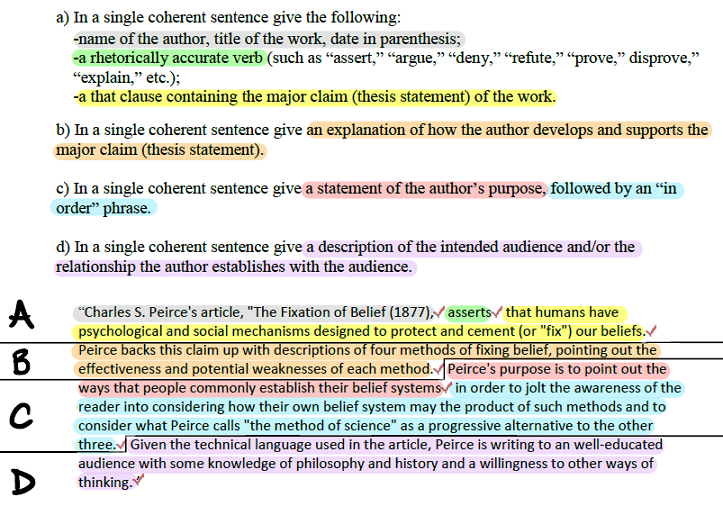
I’m going to post soon on the Robbins (2012) Political Ecology text, but I recently added the use of the four-sentence rhetorical précis format to my reading workflow, and I wanted to talk about that. Margaret K. Woodworth, an English professor, developed the format in the late 1980s for use in her courses. It forces the reader to distinguish the argument from the purpose, methods, and audience.

The idea is this:

Highlighting for illustration.

It seems formulaic and reductive, but it has done things for my comprehension and reading speed. I attack my skimming, and a little more intense reading, with filling in this “form” in mind, and emerge with a much more cogent picture of an article or chapter, and in much less time, than I was before.

I’m still getting a little lost in the more interesting ones, of course. My fatal flaw. I am fudging it a bit – the précis, as imagined by Woodworth, calls for close reading. But I don’t have time. So, I’m shortchanging the form, but it’s been a helpful remedy to my distaste and distrust of the AIC method – reading the abstract, introduction, and conclusion alone.

It’s had an interesting consequence for this blog, the purpose of which was to “write myself through” the understanding of my field statement and other comps reading. Well, the précis is doing that, and I’m leery of doubling up on writing that isn’t the actual field statement that I need to be writing. I guess that leaves the blog as my ventilation file (a la the indispensable Jensen), whether about process, pieces, personal parenthesis, pedagogy, or other parts potpourri.